
“The geographic distribution of animals impacts a range of macroevolutionary trends.“


Harriet B. Drage (University of Lausanne, Switzerland)

Stephen Pates (University of Exeter, UK)
The biotic interaction plays an important role in the evolution of groups through time. Organism-level associations or characteristic traces are the only direct evidence of biotic interactions in deep time. The available databases of fossil occurrences do not allow interaction data to be fully registered or exploited. Such data are reported in a non-standardized way for different organismal groups and time-slices, further limiting such databases to reach their full potential.
Hypothesis testing:
- Widely-dispersed trilobite groups display planktonic larval stages and/or pelagic adult life mode.
- The morphologies of larval and adult trilobites and their life modes are linked.
- The earliest global radiation of trilobites was facilitated by juvenile ecological mode.
To answer the questions:
- Is larval or adult life mode more important for driving wide geographic dispersal in trilobites?
- Does this change through the Palaeozoic, with variation in environmental and ecological factors?
Initial workshop team: Lukas Laibl (Charles University, Czechia), Maria Gabriela Suárez (University Complutense de Madrid, Spain), Luis Collantes (University of Coimbra, Portugal), Adriane Lam (Binghamton University, USA), Jorge Esteve (University Complutense de Madrid, Spain), Kelsey Lucas (University of Calgary, Canada), Fernanda Serra (Centro de Investigaciones en Ciencias de la Tierra, Argentina), Mark Nikolic (AMNH, USA), Alexis Rojas (University Linz, Austria)…. and more to join!
5. – 9. February 2024
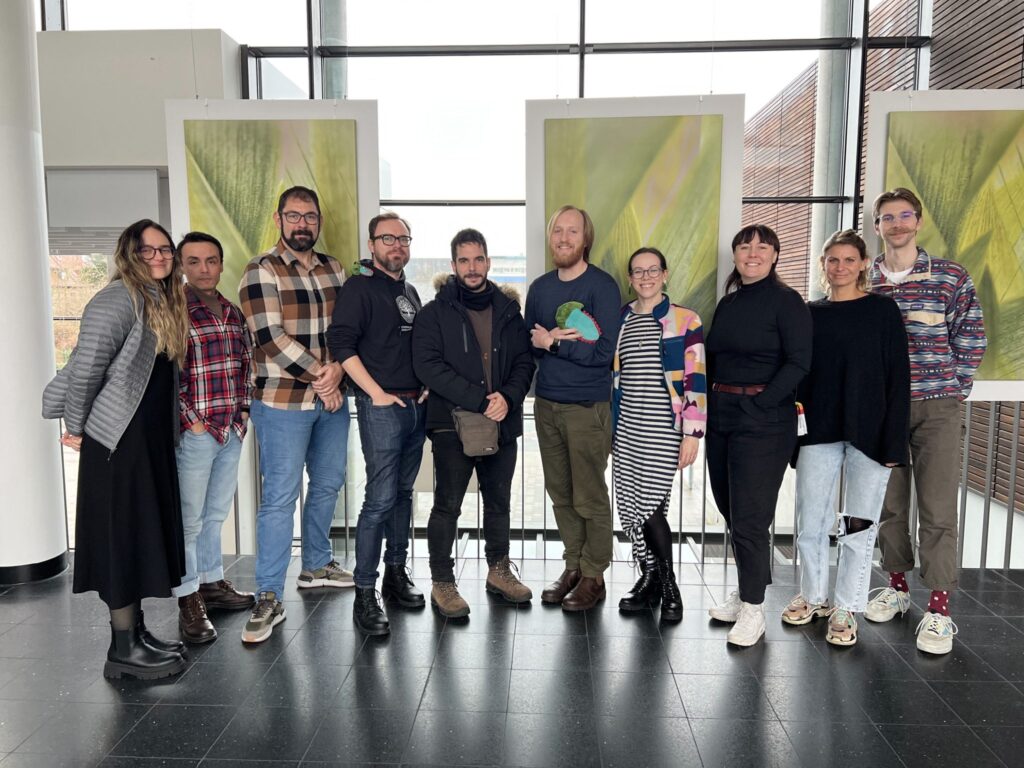
From the left: Maria G. Suarez, Alexis Rojas, Jorge Esteve, Lukas Laibl, Luis Collantes, Stephen Pates, Harriet Drage, Liz Dowding, Fernanda Serra, Mark Nikolic