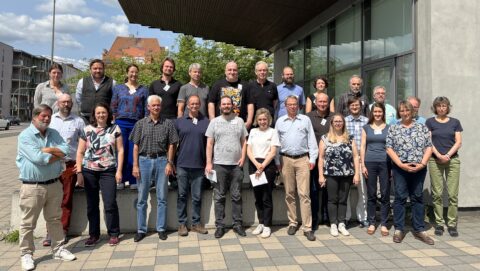
Here they are, the participants of the PaleoG workshop! The German Big Questions were discussed with great dedication and the way was paved for future joint projects. Now it's time for the participants to keep at it, people! Make something out of it...
"Drivers of reef decline are well known both today and in the geological past. Considerably less is known about the preconditions for a pantropical expansion of coral reefs. The geological record of reef building is characterised by considerably long intervals with very limited reef expansion and g...
We are happy to present the next workshop in our series. The Advisory Board has decided on TriBe, PI's are Harriet B. Drage and Stephen Pates. Click here for the workshop...
"Field courses provide transformative learning experiences that support success and improve persistence for science, technology, engineering, and mathematics majors. But field courses have not increased proportionally with the number of students in the natural sciences. We conducted a scoping revie...
"Incorporating palaeontological data into the methods and formats already familiar to conservation practitioners may facilitate greater use of palaeontological data in conservation practice. Benthic indices (e.g. Multivariate-AZTI Marine Biotic Index; M-AMBI) already incorporate reference condition...
"A new type of shell damage has been described in Ordovician brachiopods in Porambonites (Porambonites) laticaudata. There is a pair of small pits with somewhat different outline in the shell surface at the anterior commissure of the brachiopod. These pits are oriented in lateral direction, about 4...
"The amniotic egg with its complex fetal membranes was a key innovation in vertebrate evolution that enabled the great diversification of reptiles, birds and mammals. It is debated whether these fetal membranes evolved in eggs on land as an adaptation to the terrestrial environment or to control an...
"Rhynchosaurs were key herbivores over much of the world in the Middle and Late Triassic, often dominating their faunas ecologically, and much of their success may relate to their dentition. They show the unique ankylothecodont mode of tooth implantation, with deep roots embedded in the bone of the...
"Scientific knowledge is produced in multiple languages but is predominantly published in English. This academic publishing practice creates a language barrier to the generation and transfer of scientific knowledge between communities with diverse linguistic backgrounds, hindering the ability of sc...