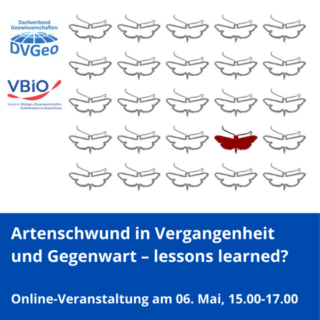
Why are more and more species becoming extinct? What can we learn from the species extinctions of the geological past? And how can we use the findings from paleontology and biology to slow down, or better still reverse, the species decline? These questions are addressed by a small online symposium ...
"The transition to open access was a pivotal point in the history of Fossil Record. The first important step to overcome this decline and to advance Fossil Record was undertaken in close cooperation with Copernicus by increasing the visibility of the journal via intensive advertising, e.g. at major...
After reviewing the submission for the Open Research Challenge, Nussaibah Raja-Schoob and Wolfgang Kiessling have decided on the winner of the challenge.
We are happy to announce Joseph Flannery Sutherland, PhD candidate at the School of Earth Sciences at the University of Bristol in the UK. Con...
"Especially in Lagerstätten with exceptionally preserved fossils, we can sometimes recognize fossilized remains of meals of animals. We suggest the term leftover fall for the event and the term pabulite for the fossilized meal when it never entered the digestive tract (difference to regurgitalites)...
"Climate change affects life at global scales and across systems but is of special concern in areas that are disproportionately rich in biological diversity and uniqueness. Using a meta-analytical approach, we analysed >8000 risk projections of the projected impact of climate change on 273 areas...
"Understanding the origin, expansion and loss of biodiversity is fundamental to evolutionary biology. The approximately 26 living species of crocodylomorphs (crocodiles, caimans, alligators and gharials) represent just a snapshot of the group's rich 230-million-year history, whereas the fossil reco...
Our recent newsletter is out! We've already sent it to those that actively participate and those that are interested in Paleosynthesis and told as they would like to keep informed. You can download it here.
The deadline for FAU's Open Research Challenge is over and we would like to thank everyone who participated and supported. Now it is time to review and rank the submitted solutions. This will be done by Nussaibah Raja-Schoob and Wolfgang Kiessling and as soon as we have our results we will in...
"The Earth has been beset by many crises during its history, and yet comparing the ecological impacts of these mass extinctions has been difficult. Key questions concern the kinds of species that go extinct and survive, how communities rebuild in the post-extinction recovery phase, and especially h...
"Heteromorphs are ammonoids forming a conch with detached whorls (open coiling) or non-planispiral coiling. Such aberrant forms appeared convergently four times within this extinct group of cephalopods. Since Wiedmann's seminal paper in this journal, the palaeobiology of heteromorphs has advanced s...