"Aim: Environmental niche tracking is linked to the species ability to disperse. While well investigated on large spatial scales, dispersal constraints also influence small-scale processes and may explain the difference between the potential and the realized niche of species at small scales. Here w...
"Aim: Adaptive radiation, in which successful lineages proliferate by exploiting untapped niche space, provides a popular but potentially misleading characterization of evolution on oceanic islands. Here we analyse the respective roles of members of in situ diversified vs. non-diversified lineages ...
"Findings of ammonoid soft tissues are extremely rare compared to the rich fossil record of ammonoid conchs ranging from the Late Devonian to the Cretaceous/Paleogene boundary. Here, we apply the computed-tomography approach to detect ammonoid soft tissue remains in well-preserved fossils from the ...
"Conodont dental elements are distinguished by their high disparity and rapid morphological evolution. P1 elements located in the pharynx are the most rapidly evolving, but their function in the animal has been only investigated in a handful of taxa and proposed to be analogous to mammal molars. Th...
"Limestone–marl alternations are commonly used for high-resolution cyclostratigraphic studies and palaeoenvironmental reconstructions, but diagenetic studies indicate that not all limestone–marl alternations reflect genuine differences in the initial sediment composition driven by environmental cha...
"Palaeozoic stromatoporoids, throughout their 100-million + year history (Middle Ordovician to Late Devonian and rare Carboniferous), are better preserved than originally aragonite molluscs, but less well-preserved than low magnesium-calcite brachiopods, bryozoans, trilobites and corals. However, t...
"The Triassic (252–201 Ma) marks a major punctuation in Earth history, when ecosystems rebuilt themselves following the devastating Permian-Triassic mass extinction. Herbivory evolved independently several times as ecosystems comprising diverse assemblages of therapsids, parareptiles and archosauro...
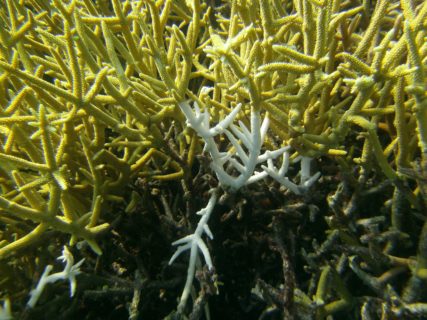
PhD candidate Nussaibah Raja-Schoob and Wolfgang Kiessling, with colleagues, published a study on the extinction risk of corals using artificial intelligence. An article is published in 'Global Ecology and Biogeography' and the university has published an interview with N. Raja-Schoob and W. Kiessl...
"Results: Model validation confirmed 77% accuracy in predicting extinction risk of fossil corals. Extinction risk predicted by our model showed a near-random (57%) match with the IUCN conservation status. Our model also suggested that corals in the Least Concern or Near Threatened categories might ...
"Coralline algae that form rhodoliths are widespread globally and their skeletal growth patterns have been used as (paleo-) environmental proxies in a variety of studies. However, growth interruptions (hiati) within their calcareous skeletons are regarded as problematic in this context. Here we inv...