"Nuskoisporites dulhuntyi is considered one of the biostratigraphic marker species for the Lopingian of Europe. A morphological comparison between Kungurian (Cisuralian) and Wuchiapingian (Lopingian) Nuskoisporites dulhuntyi prepollen (dispersed from five outcrops and in situ from one cone) from th...
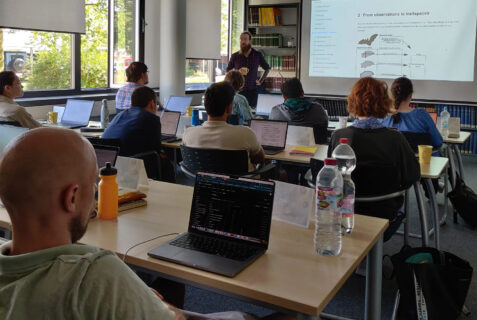
As our first external lecturer during the Summer School we are pleased to welcome Thomas Guillerme from Sheffield. Thomas is teaching on analyses relating to morphology.
On Monday we started the third PaleoSynthesis Summer School. All students arrived safely and are once again being prepared for scientific analyses by our team and external colleagues. Thanks to the generous support of the Volkswagen Foundation, we were able to guarantee financial support for the pa...
We are proud to present the latest Workshop Icon! Our FAU designers have once again done a great job and created a very individual icon for IRATE... including some paleo cliché with a dino :)
We are pleased to announce the newest workshop in PaleoSynthesis. The Scientific Advisory Board critically evaluated and discussed incoming applications. We welcome IRATE (International Research workshop for the Advancement of Taphonomic Experiments) and the PI's Orla Bath-Enright and Thomas Clemen...
Preprint: "Controversies exist regarding the extent of past human influence on terrestrial ecosystems and the relative importance of human versus climatic factors in shaping Holocene vegetation. However, there has been no systematic examination of these issues at a global scale.
Here we integrat...
"Molecular and fossil evidence suggests that complex eukaryotic multicellularity evolved during the late Neoproterozoic era, coincident with Snowball Earth glaciations, where ice sheets covered most of the globe. During this period, environmental conditions-such as seawater temperature and the avai...
"In the face of rising global temperatures, coral reefs experience coral mass bleaching and mortality. Subtropical and mesophotic environments may represent refugia for reef corals under climate change, where they can survive and eventually recolonize degraded areas. Using a comprehensive database ...
This week the MURKY workshop is held in Erlangen. Eleven externals joined the meeting starting on Monday. The team will be working on their topic for the entire week to push forward. More on MURKY
"The Cenozoic evolution of the Tethyan seaway significantly shaped marine and terrestrial biota around Eurasia. The Tethys connected the Atlantic and the Pacific during the early Cenozoic, allowing marine faunal exchange. However, during the Early Miocene, the “Gomphotherium Landbridge” developed, ...