"Evolutionary relationships of fossil gastropods have largely been inferred using taxonomic systematics. Phylogenetic relationships between extinct gastropod groups and their relationship to extant groups are largely unresolved. Here we reconstruct the phylogeny of Pleurotomariida, which has the lo...
"This study focuses on newly collected plant fossils from the Cisuralian successions of the Khenifra Basin in Central Morocco, revealing a diverse assemblage dominated by conifers, pteridosperms, and sphenophytes. The assemblage includes eleven taxa of vegetative and reproductive organs preserved a...
"Phylogenetic models are commonly used in palaeobiology to study the patterns and processes of organismal evolution. In the human sciences, phylogenetic methods have been deployed for reconstructing ancestor–descendant relationships using linguistic and material culture data. Within evolutionary ar...
"Aim: To determine the degree to which assemblages of planktonic foraminifera track thermal conditions. Location: The world's oceans. Time Period: The last 700,000 years of glacial–interglacial cycles. Major Taxa Studied: Planktonic foraminifera. Methods: We investigate assemblage dynamics in plank...
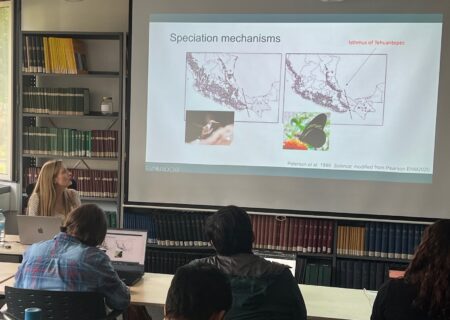
The PaleoSynthesis Summer School is coming to an end. The last two days are presented by Erin Saupe from Oxford University. Erin is teaching on Spatial Subsampling and Niche Modeling and was already part of the past two summer schools.
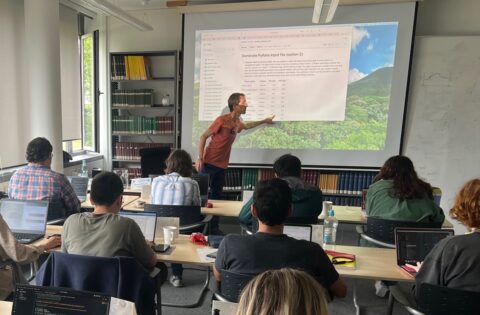
It continues, the last week Summer School has begun and Daniele Silvestro (University of Fribourg, Switzerland) has taken over the scepter. Topics are: PyRate and AI-based diversity.
The decision for the last PaleoSynthesis PostDoc has been made. All candidates invited to the interview presented themselves outstandingly. However, together with the Advisory Board, which took part in the interviews, Danijela Dimitrijevic came out on top in the end. The decision was unanimous and ...
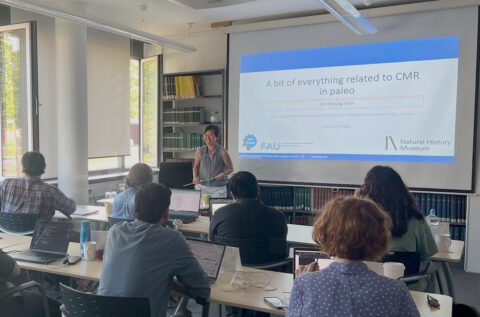
Hot summer and hot topics! Lee Hsiang Liow is our 2nd external teacher at the Summer School. She brought CMR Methods and Time Series Analyses with her from Olso; hopefully the students won't break out in a sweat 😅
"Hard substrate communities can impact coral reef growth by adding or removing calcium carbonate when they act as encrusters or bioeroders, respectively. Although such sclerobiont communities are known across the Phanerozoic, the Triassic saw a substantial increase in reef macrobioerosion. This stu...
"Phylogenetic estimation is, and has always been, a complex endeavor. Estimating a phylogenetic tree involves evaluating many possible solutions and possible evolutionary histories that could explain a set of observed data, typically by using a model of evolution. Modern statistical methods involve...